

 Beach Club
Sunbeds, private cabanas, pool and house music, 11 AM–10 PM daily.
Yes. Morjim Beach is one of North Goa's easier swimming beaches because the water stays shallow for some distance from the shore. Three conditions apply: swim only between the Drishti lifeguards' red-and-yellow flags, keep away from the Chapora river mouth, and stay out entirely in the monsoon (roughly June–September), when red flags go up.
By Anurag Kamboj · Updated
Beach Club
Sunbeds, private cabanas, pool and house music, 11 AM–10 PM daily.
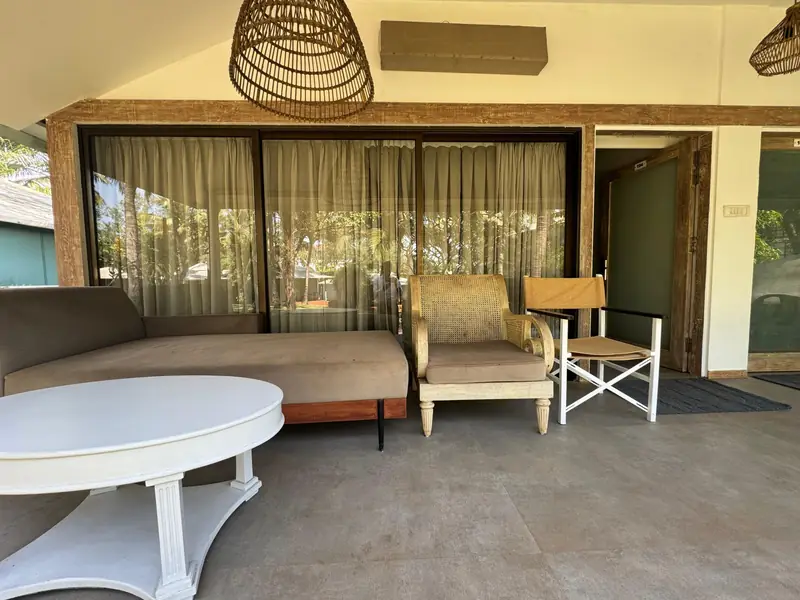 Luxury Cottage
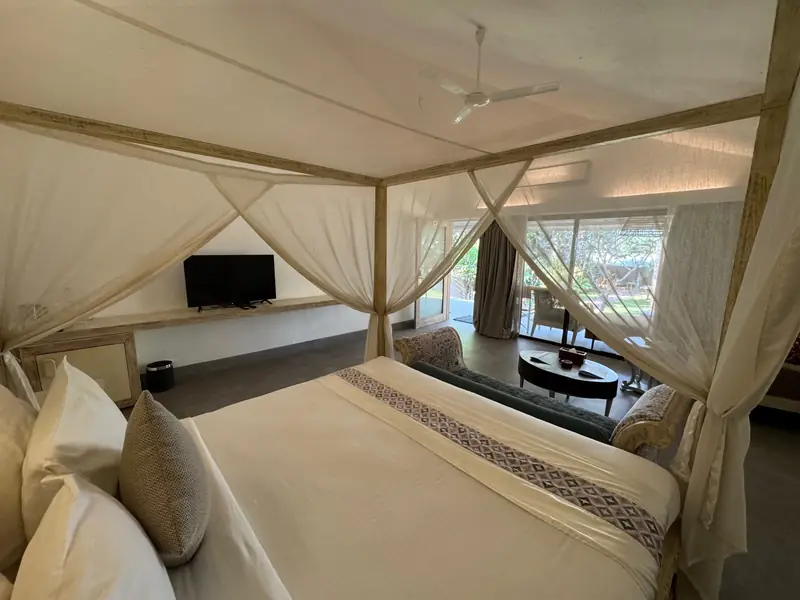 Villa Room
You can swim at Morjim in every month except the monsoon ones, and even then the final word belongs to the flags you see that morning. Use the table as a guide, not a forecast.
| Months | The sea at Morjim | Swimming |
|---|---|---|
| June–September | Monsoon: heavy rain, rough sea, red flags up | No. Swimming is not allowed. |
| October | Settling after the monsoon; shacks reopening | Only where lifeguards have set out swim-zone flags |
| November–February | Dry peak season, busiest beach | Yes, between the red-and-yellow flags |
| March–May | Hotter and quieter; tides and currents still change | Yes, between the flags |
One thing a table can't show: the flagged zone can move. Check where the flags are each time you walk down, rather than heading for yesterday's spot.
Morjim Beach feels gentle because you can walk a long way out before the water reaches your chest. That same shallowness is what catches visitors out. Sandbars form and disappear with the tide, so a patch you stood on at 10 AM can be a deeper channel by early afternoon, with water running back out to sea between you and the beach. Morjim also sits on the northern bank of the Chapora river estuary, and water near a river mouth behaves differently from the open beach, so the end nearest the estuary is the part to treat with most caution. Currents are not always visible. A calmer-looking or foamy strip heading away from the shore can be one. Caught in a pull? Don't fight straight back towards the sand. Swim parallel to the beach until it lets go, then come in at an angle, and raise an arm so a lifeguard can see you.
A red-and-yellow flag marks a swimming zone watched by Drishti lifeguards, and a red flag means nobody should be in the water. Drishti, the lifesaving agency appointed by the Goa government, patrols the state's beaches, including Morjim, and the signals are simple.
Two more rules sit alongside the flags. Drinking on Goa's beaches is banned, with fines of ₹2,000 for individuals and ₹10,000 for groups, and a swim after a few beers is a bad idea anywhere. Save 112, India's single emergency number for police, ambulance and fire, before you go down to the sand.
Morjim is one of the better North Goa beaches for children, with conditions. The slope into the sea is gradual, the sand is soft rather than rocky, and there are fewer jet skis and banana boats crossing the water than at Calangute or Baga, where water-sports operators are concentrated. Ashwem, about 2–3 km north, and Mandrem, about 6–7 km, share much of that shape. Anjuna and Vagator are harder with small children because rocks run into the sea. None of this makes a beach safe on its own. A toddler can be knocked over by a wave in knee-deep water, and armbands slip. The simplest routine at Morjim is to pick a spot opposite the lifeguard post, keep young children within arm's reach even in shallow water, and save the sea for the morning and late afternoon, leaving the midday sun for shade.
| Beach | Shoreline | With young children |
|---|---|---|
| Morjim | Long, flat, sandy; shallow near the shore | Good, between the flags; avoid the estuary end |
| Ashwem | Sandy and quiet | Good, between the flags |
| Mandrem | Sandy and quiet | Good, between the flags |
| Calangute and Baga | Sandy, crowded, boats offshore in season | Manageable; stay close in busy water |
| Anjuna and Vagator | Rocky outcrops and cliffs | Harder; rocks run into the sea |
For places to stay, see our guide to resorts in Goa for families with kids.
Not during the day. Olive Ridley turtles nest at Morjim from late December to March, with most nests laid January–March; Daijiworld reported the first nests of the last two seasons on 25 December 2024 and 26 December 2025. The Goa Forest Department moves the eggs to a fenced hatchery, where they incubate for about 45–52 days. The rules are about the sand, not the sea: keep away from fenced areas, don't shine torches or phone lights on the beach after dark, keep noise down and follow forest staff instructions. That also rules out a moonlit swim, which is a poor plan anyway with no lifeguards on duty at night. Our Morjim turtle beach guide explains the season.
When a red flag is up, switch to a pool rather than trying your luck at the edge of the zone. Marbela Beach Resort, on Morjim Beach, has an outdoor pool with sunbeds at its beach club, open 11 AM–10 PM daily. The pool is shared, not private, and it sits a few steps from the sand, so you can keep an eye on the flags and go back to the sea when the zone reopens. Cabana and day-visit prices aren't published; call or WhatsApp +91 91588 81185 for current rates.
Travelling between June and September? Sea swimming is off the table across Goa then, so read whether Goa is worth it in July and August before you book. Room reservations are on +91 91588 81185 or +91 91588 81183.
Yes. Drishti lifeguards patrol Goa's beaches, including Morjim, and mark the supervised zone with red-and-yellow flags. Outside those flags nobody is watching for you.
Yes, for most swimmers. Morjim is long and sandy with shallow water near the shore, while Anjuna and Vagator have rocks running into the sea. The flag rules apply at all three.
Sometimes. October is the post-monsoon changeover, so swim only on days when lifeguards have set out red-and-yellow flags, and stay out whenever a red flag is flying.
Finish before the light goes. Goa sunsets fall roughly between 6:00 PM and 7:10 PM depending on the month, and it gets dark quickly afterwards, when nobody on shore can see you.
Alert the nearest lifeguard straight away and call 112, India's emergency number. Throw something that floats rather than swimming out yourself unless you are trained.
About the author
Anurag Kamboj is a Goa explorer and travel writer who puts together Marbela Beach Resort's guides to Morjim and North Goa, from airport routes and beach-safety rules to turtle season and where to sit for sunset.
How these guides are researched →